Yum: The New Language of Wine

tasting journal, tasting notes, moleskine journal

Typical page of notes for a winery.

On my recent Gold Country wine tasting trip, I travelled with a group of friends.  Some of them were using my book, Pour Me Another, to keep track of their tasting and to get an overview of each of the wineries that we visited.   I encourage wine drinkers to keep track of the wines they taste when they are out tasting.  I have posted about this before.

It was the end of our first day of tasting.  We were at Crystal Basin Cellars.  We had been tasting all afternoon.  I leaned over to my friend as he was making a note in the book and asked, “What do you think of this wine?”

He looked at me with a little bit of fear and said, “I don’t know any of the language to describe wines.  I just wrote ‘yum!’”

“That’s perfect!” I said.  And I meant it.  I continued, “When I was writing my book, I used my tasting notes.  For one entry, I referred back to my notes about a specific wine and found that all I’d written was, ‘I wish I had a car this color’”.

My friend laughed and relaxed.  Taking notes for me, somebody who is writing about wine, is a different activity than for others who don’t aspire to that, though clearly, my note taking skills need improvement.  For my friend, it was enough to write “yum!” because that summed up what he needed to know about that wine: he liked it…he really liked it.

And his simple note inspired me to continue my struggle to write about wine without falling into one of the two camps of tasting note writing.  The first group is the one we are most familiar with: lots of descriptions of smells and tastes using words like floral, smokey, jammy, stone fruit, cherry, and all the rest.  The second group sticks solely to the facts: what grape varietals are used to make it, where it’s from, how much alcohol it has and whether it is a simple or complex wine.

Some notes combine both these methods.  But these kinds of notes don’t tell me what it’s like to drink the wine.  That is my goal as a writer about wine: finding a way to write about a wine that avoids the clichés of the overly descriptive tasting note and provides more subjective information than the purely factual tasting note.  I have come nowhere near achieving this goal, but it’s where I’m headed.

I’d love to hear what you think about tasting notes and how you use them.

“Yum”, is it the new language of wine?

Keeping Tasting Notes

keeping tasting notes, moleskine notebook

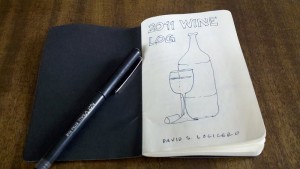
I used a small paper bound Moleskine notebook

I am a big advocate for keeping tasting notes.  Being a fan of the analog life, I still keep my notes using the old fashioned tools called pens and paper.  The photo above is of the notebook I used while writing my book, Pour Me Another.  It is a handy size and fits right in my shirt pocket along with a decent pen.

tasting journal

Yes, I decorate the book, I’m an architect after all.

Being the architect that I am, I took the time to make a little sketch on the first page.  It’s silly and nobody sees it but myself.  It makes me happy.

Aside from being a memory prompt for later when I’m writing, or trying to make decisions about wines to buy or food pairings, the journal actually helps me taste the wine rather than drink it.  Keeping the notes helps me to slow down and pay attention to the wine in a purposeful way.  It makes my tasting a deliberate activity, not simply the consequence of drinking.

tasting journal, tasting notes, moleskine journal

Typical page of notes for a winery.

The photo above is of a typical winery’s page of notes.  I note the name of the winery, and the date at the top.  If there is a tasting fee I note that as well.  Then I simply note the vintage and the name of the wine and my observations about the color, nose and taste.  If it is a blend, I’ll try to write down the percentages of the different varietals.  You’ll note in this one that the 2007 Riserva Sangiovese has blanks marked for the 1% of this and the 1% of that that I forgot.  But come on, it’s 98% Sangiovese!

This little notebook has been an invaluable tool, not just for the purposes of writing the guide book, but also for my own education about the wines of Amador and El Dorado County.  I wish that I had started keeping notes earlier.

I’m currently starting to research two new guides.  I am going to be experimenting with two other tasting journal formats.  I’ll be using the De Long Wine Tasting Notebook for one region and the Moleskine “passions” Wine Journal for the other one.  I’ll be comparing them to one another and to my own improvised journal.  Stay tuned for wine journal updates!